

Aquatabs contain NaDCC (sodium dichloroisocyanurate) as the active ingredient. When dissolved in water, they release free chlorine (HOCl / OCl-) for disinfection. Commonly used for drinking water purification and emergency water treatment.
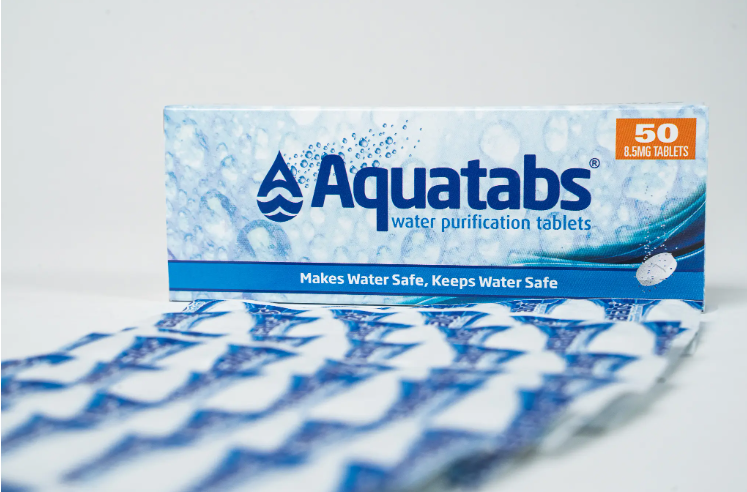
Low-dose Aquatabs (e.g., 1.67 mg) are ideal for small volumes. One 1.67 mg tablet in 1.5 L of water gives approximately 1.1 ppm, which falls within the recommended safe range of 0.5–5 ppm for drinking water during camping or trekking. If 1.67 mg tablets are not available, half of a 3.5 mg tablet can be used as an alternative.
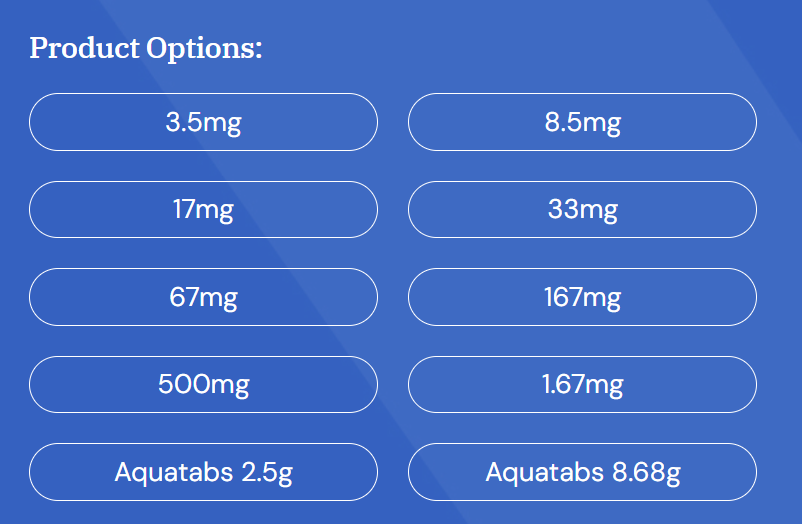
However, in some areas only high-dose tablets (e.g., 500 mg, typically meant for 150 L water tanks) are available. In such cases, direct use is not practical for small volumes.
Safety Note:
Do not directly estimate or fraction high-dose tablets in the field. Prepare a high-strength stock solution, then use a small measured amount from it to treat drinking water to ~1 ppm.
Stock Solution:
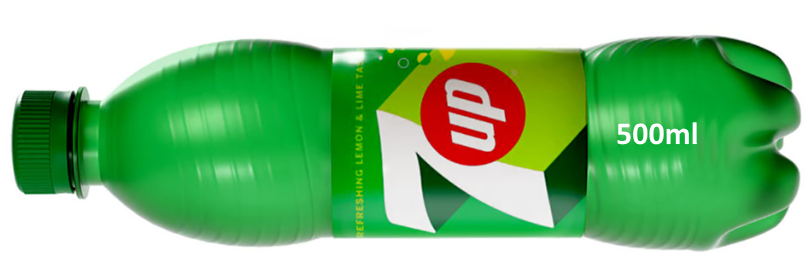
A small ~500 mL 7up bottle works well for the stock solution. Its dark green color helps reduce light exposure (protecting chlorine), and keeping it in a backpack further limits sunlight and heat. The tight cap also helps minimize chlorine loss due to gassing. Below is a simple method to do this:
1 ppm = 1 mg/L (for water)
Typical composition of Aquatabs (NaDCC formulation) as per Medentech (manufacturer) literature is:
- Troclosene sodium (NaDCC) – active chlorine source (~up to 60% available chlorine equivalent).
- Adipic acid (~28%) – pH modifier that enhances chlorine effectiveness in solution.
- Sodium carbonate (~12%) – stabilizer and effervescent agent aiding dissolution.
This means the labeled tablet mass is not entirely available chlorine. Available chlorine will be 60% of 500 mg (theoretical maximum).
500 mg × 0.60 = 300 mg, So:
- In 1 L, 300 mg/L = 300 ppm
- In 0.5 L (500 mL), 300 mg/L = 600 ppm (same amount of chemical in less water = higher concentration).
Therefore stock solution = 600 ppm
1PPM Solution
Next step is to calculate how many mg you need to make 1 ppm in 1.5L. A typical Nestle drinking water bottle is 1.5L that's why considering this 1.5L value.
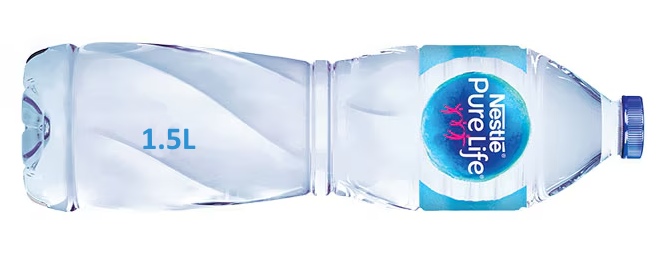
If 1mg in 1L is 1ppm and 2mg in 2L is 1 ppm then 1.5mg in 1.5L is also 1ppm. Mathematically:
- 1ppm = 1mg / 1L
- 1ppm = X(mg) / 1.5L
- X = 1 x 1.5 = 1.5mg
So you need 1.5mg from your stock solution to transfer it to your 1.5L bottle to make it 1ppm. Since stock solution is in ml, next step is to calculate how many ml will 1.5mg be?
Our stock solution had 300mg in 500ml. Mathematically:
- 300mg --- 500ml
- 1mg --- 500/300 = 1.66 ml
- 1.5mg --- 1.5 x 1.66 = 2.5ml
So taking 2.5ml from stock solution and transferring it into 1.5L water bottle will make the drinking water 1ppm in strength.
Dosage
Use a small syringe to draw 2.5 mL from the stock solution. It’s lightweight, easy to carry, and allows precise measurement.
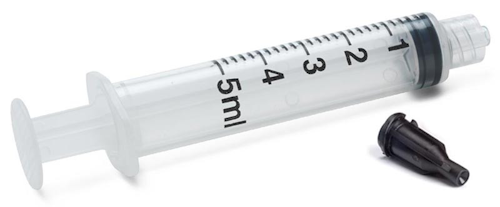
Note: 1 ppm of chlorine from Aquatabs (NaDCC) is generally not enough for safe drinking water in a camping or backcountry setting. While 1 ppm is a standard target for municipal tap water, it is insufficient for "raw" or "wild" water because it does not provide a high enough concentration to reliably kill resistant parasites like Giardia in a short period.
- Standard Camping/Backcountry Dose: Manufacturers and health experts recommend a dosage of at least 2 mg/L (2 ppm) for clear natural water.
- Dirty/Turbid Water Dose: If the water is cloudy or "high risk," you should increase the dose to 5 mg/L (5 ppm).
- Wait Time: Regardless of the ppm, you must wait at least 30 minutes after the tablet fully dissolves before drinking.
- Pre-Filter: Always filter cloudy or muddy water through a cloth or a dedicated filter before adding tablets. Sediment "eats" the chlorine, leaving less to kill germs.
- Temperature: If your water is very cold (near freezing), you should double the wait time or the dosage.
Experimental Testing:
Based on the above preparation, it was calculated that 2.5 mL of stock solution in 1.5 L water would produce 1 ppm free chlorine. To check this, free chlorine was measured using a high-quality Taylor test kit.
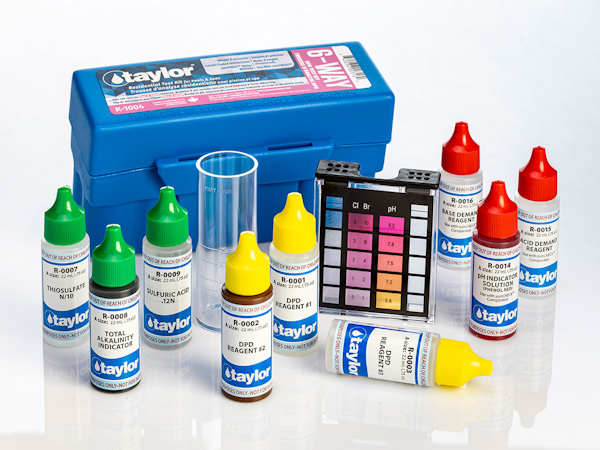
However, actual testing showed deviation from the theoretical value i.e. 4 mL of stock solution in 1.5 L produced ~1 ppm, rather than the calculated 2.5 mL which produced less than 1 ppm.
This indicates that the effective free chlorine availability in the prepared stock solution is lower than theoretical assumptions, likely due to:
- Incomplete or delayed chlorine release from NaDCC.
- Chlorine demand from water impurities.
- Storage-related degradation of active chlorine.
- Non-linear response of low-range chlorine measurement (Taylor kit sensitivity at low ppm levels).
- Practical difference between “available chlorine potential” and “measurable free chlorine”.
- Variability in product performance or reduced actual chlorine release under practical conditions.
Stability Observation:
The same 1.5 L prepared solution was retested after 7 days:
- It showed 0 ppm free chlorine (complete decay).
- When 4 mL from the same aged stock solution was added again to the same 1.5 L sample, it measured ~1 ppm.
- However, when 4 mL from the same aged stock solution was added to a fresh water sample, it measured only ~0.5 ppm.
This suggests that the effective strength of the stock solution decreased by approximately 50% over one week.
Conclusion
Theoretical calculation (based on 60% available chlorine):
- 2.5 mL --- 1 ppm in 1.5 L
Experimental result:
- 4 mL --- 1 ppm in 1.5 L
This suggests that the effective working concentration of the stock solution is closer to ~375 ppm, corresponding to approximately 188 mg of active chlorine (38% of 500 mg, not 60%) in 500 mL, instead of the theoretical 600 ppm. The discrepancy arises from the difference between theoretical available chlorine (manufacturer specification) vs measured free chlorine under real-world conditions. Despite this variation, the method remains:
- Consistent
- Predictable
- Conservative and safe for field use

💬 Comments
Please Login to Comment!